Built to Leave · Jeff James & Marc Tillery
We built a finish line and called it graduation.
Between 64 and 75 percent of young people raised in Christian homes disengage from church by their mid-twenties. It isn’t an information problem. It’s a relational one — and it’s built into how our churches are structured.

Four decades in the field
15,000+ young people
Majestic Mountain Ministries · TEAM Ascend
Retreats in Twin Lakes, Colorado
The problem
An exodus we didn’t see coming
These aren’t the children of nominal believers. Many come from the most committed families in our congregations — Sunday school, youth group, camps, mission trips, baptism. And still, they left.
Up to
75%
of young people raised in Christian homes disengage from church by their mid‑twenties.
70%
of young adults who attended church regularly in high school quit by age 23. Only 35% eventually return.
1 in 7
high school seniors felt prepared for the faith challenges of college (Fuller Youth Institute).
20%
of those who left had planned to while still in high school. Most didn’t walk out. They drifted.
Sources cited in Built to Leave: LifeWay Research; Fuller Youth Institute, College Transition Project; National Study of Youth and Religion; Pew Research Center.
A face behind the numbers
“I didn’t storm out. I drifted. After graduation, I moved two hours away for college. The first Sunday, I meant to find a church. I really did. But I didn’t know anyone… Next week became next month. Next month became next semester. I just knew something was broken, and I didn’t know how to fix it. So I stopped going.”
“Rachel,” 24, former youth group leader
Rachel is not an anomaly. She is the majority. She didn’t reject God so much as lose the relational infrastructure that connected her to Him — and her church had no way to follow her into the next chapter.
Why they leave: three gaps
Better curriculum and louder calls to commitment don’t close these. Relationships do.
The Knowledge Gap
They knew about God but didn’t know God. They could answer Bible trivia but didn’t have a relationship that could survive doubt.
The Authenticity Gap
They saw performance more than genuine faith — adults going through the motions — and concluded that’s all Christianity is.
The Purpose Gap
They never found their place in God’s mission. Spectators, not participants. Consumers, not contributors.
46%
of Gen Z men reported attending church in the past week (Barna Group, 2025).
Some are coming back. Is your church ready?
Those returning are looking for exactly what this book prescribes: authentic relationship, intergenerational connection, depth over entertainment. Their return is fragile. The question is whether the church they return to has changed — or whether it will lose them again the same way it lost them before.
We build climbers.
On a mountain, a guide can short-rope a client to the summit. The client gets the view — but never learns to climb. Youth ministry has been short-roping for decades: borrowed faith experiences instead of personal encounter, leaving young people unequipped when the rope is cut.
This isn’t a critique of youth workers. It’s a critique of a structure we all inherited — and a way to rebuild it.
Read the whole book free — before launchThe answer: The Loop
Not a program to implement. A posture to embody.
Faith doesn’t move in a straight line from doubt to certainty. It enters through Invitation, then cycles through three relational epochs that deepen over a lifetime — each pass adding a ring, like a tree.
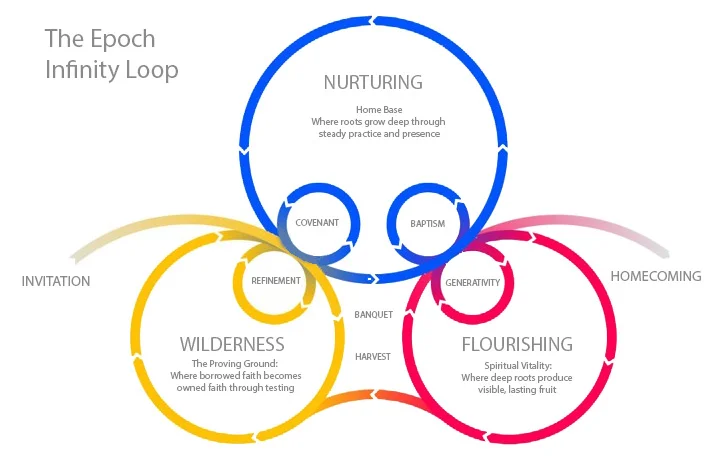
Nurturing
Home Base
Where roots grow deep through steady practice and presence.
Wilderness
The Proving Ground
Where borrowed faith becomes owned faith through testing — and where the graduation model lets go.
Flourishing
Spiritual Vitality
Where deep roots produce visible, lasting fruit.
Along the way, Banquet moments — divine encounters — and Harvest seasons of return and reintegration arrive unpredictably, in any epoch. They can’t be manufactured by programming.
For pastors & leadership teams
Measure discipleship in decades, not semesters
This is not a youth ministry issue. It’s a church-wide culture issue — and it starts with leadership. Here’s a path your team can walk together.
01
Read it as a leadership team
Senior pastor, staff and elders read Built to Leave together.
02
Work the Leadership Discussion Guide
Surface your church’s specific gaps and build alignment around the problem.
03
Equip your youth staff
A Field Guide for Youth Ministers shows what they can do now, before students leave.
04
Bring in the whole church
The six-session Small Group Discussion Guide asks every adult to invest in one young person.
Bring Built to Leave to your church
Speaking & workshops
Jeff and Marc for staff retreats, leadership gatherings and conferences.
Leadership retreats
Experience the Loop on the mountain at our retreat facility in Twin Lakes, Colorado.
Bulk copies
Discounted sets for elder boards, staff and small group leaders.
The companion app · Coming soon
Keep the connection after graduation
Twelvos is a free discipleship app from Majestic Mountain Ministries. Jesus had twelve and kept three closest. Twelvos keeps a student’s closest people one tap away, wherever life takes them after graduation.
Field-tested, not theorized
Jeff and Marc came to the Colorado mountains as teenagers in 1986 and have led wilderness trips together since 1988 — four decades and more than 15,000 young people.

Jeff James
Co-founder, Majestic Mountain Ministries and the TEAM Ascend Program. Read the full story.

Marc Tillery
Co-founder, Majestic Mountain Ministries and the TEAM Ascend Program. Read the full story.
Free advance copy · 250 church leaders
Read it before anyone else
Before launch, we’re giving 250 church leaders the complete digital edition of Built to Leave — free, through January 1, 2027. No purchase or review required.
Claim your free copyQuestions about the book
What is Built to Leave about?
Built to Leave, by Jeff James and Marc Tillery, explains why between 64 and 75 percent of young people raised in Christian homes disengage from church by their mid-twenties. The cause is relational, not informational: the church’s faith formation model ends relational investment at graduation, just as young people enter the season when faith is most vulnerable.
Who is the book for?
Pastors and church leadership teams first, along with youth workers and parents. It is written to be read together by a leadership team, with companion guides for staff, youth ministry and small groups.
What is the Loop?
The Loop is the book’s framework for how faith develops across a lifetime. Faith enters through Invitation, then cycles through three relational epochs — Nurturing, Wilderness and Flourishing — that deepen over time, instead of moving in a straight line from doubt to certainty.
What is short-roping?
In mountaineering, a guide short-ropes a client to pull them up a climb. The book uses the term for youth ministry that gives young people borrowed faith experiences instead of building faith they own — which leaves them unequipped when the rope is cut at graduation.
When can I read it?
The book has not launched yet. Through January 1, 2027, the first 250 church leaders who sign up receive the complete digital edition free. Claim your free advance copy.
What is Twelvos?
Twelvos is a free discipleship app from Majestic Mountain Ministries, coming soon, that helps churches stay connected to young people after graduation. Join the church waitlist.